3 Simple Parenting Tips You Don’t Normally Hear

Parent Newsletter

by Jonathan McKee – at TheSource4Parents.com

On Monday nights when our girls were growing up, Cathy and I would take them to the Golden Spoon for frozen yogurt after dinner. The weekly yogurt run was part of our family identity — part of what made us who we were. Even the neighbors knew our routine and sometimes shouted to-go orders as we pulled out of our driveway. Our three daughters are now grown, but when our family gets together, we still make trips to the Golden Spoon. It’s one of those simple traditions that have kept our family bonds strong.

Not surprisingly, a strong family identity also helps children develop a strong and healthy self-identity. Knowing what makes their family unique — traditions, values, and ways of relating to one another — gives children a clear starting point for discovering their own place in the world. Studies have shown that kids who identify with their family’s values tend to be less promiscuous and face less risk of drug and alcohol abuse.

I’m a big fan of parents who make the effort to build a strong family identity. But how is it done? Here are three principles that I believe are critical to the process.

1. Be present. Children regard your presence in their lives as a sign of care and connectedness. Families who eat meals together, play together, and build traditions together thrive. Your presence matters! Does your family eat together at least four times a week? If so, there is a greater chance your kids will perform better in school and be less likely to exhibit negative behavior.

2. Celebrate everything! Don’t miss a single chance to celebrate your family. You can celebrate birthdays, graduations, and other rites of passage, but don’t miss out on celebrating life’s smaller occasions such as Little League victories, learned skills, and school achievements.

3. Talk about faith. For some families, spiritual discussions are easier said than done. But having faith conversations with your kids helps to build your family identity. They also help your kids build strong convictions, as they get older. When you regularly expose your kids to God’s truth, it can, as a friend of mine says, “help them develop a sweet tooth for Jesus.” And that’s something far better than buying your kids frozen yogurt at the Golden Spoon.

Advent Calendar for Your Family!

Every good and perfect gift comes from God. In fact, His most perfect gift was His only Son, Jesus.

Gather your family and continue reading the story of Christmas one day at a time using the Advent Calendar.

The Scripture and prompts will take your family on a journey to generosity, leading you to appreciate the season together in a whole new way.

Click on the Downloads Below.

AdventCalendar_8_5x11_2017

AdventCalendar_11x17_2017

AdventCalendar_Multi_2017

Adolescence: A Season of Pressure

Doug FieldsAuthor of Intentional Parenting

On the outside, most young people seem happy-go-lucky, but inside each adolescent is a complex network of potentially explosive pressures. Adolescents with a strong parental and social support system are the least likely to experience the painful effects of the pressures they face. When parents become aware of the typical sources of pressure that kids face, they are better able to provide their kids encouragement and support. Here are five common pressures adolescents face:

1. The Pressure to be Perfect.
Teens repeatedly talk about their parents wanting them to be perfect, particularly in in the areas of behavior and school. No kid is perfect and when they fall short of their parents’ expectations, they feel more pressure.

2. The Pressure to Succeed.

READ MORE HERE

Parent Cue Road Signs Series

Have you thought about the path your family is taking?  What direction would you like to REALLY GO, but don’t seem to know how?  Proverbs helps us take our intentions and give direction to the destination by first “pondering the path.”

Proverbs Chapter 4

25 Let your eyes look directly forward, and your gaze be straight before you.
26 Ponder the path of your feet; then all your ways will be sure.
27 Do not swerve to the right or to the left; turn your foot away from evil.

FAMILY EXPERIENCE

What kind of family do you want to be? What shared experiences do you want to have? What kind of legacy do you want to leave? This month, think about one goal, one destination, you want to reach as a family. Maybe you want to become more environmentally conscious. Maybe you want to serve others. Maybe you want to feel closer to each other. When you decide on your destination, then you can make a road map for getting there. Here are just a few questions to help you start planning your journey.


  1. What is your biggest obstacle in taking the first step? Everyone has some reason why you can’t do something. Find out what that big fear or reason is, and determine what is the best way to push through that roadblock.


  1. Is there something you need to stop doing in order to free up time to get to your chosen destination? For example, if you want to grow closer as a family, what time do you need to carve out of your schedule to spend time together on a consistent basis?


  1. Are there tools or materials you need in order to equip you for the path? For example, if you want to become more environmentally conscious, do you need to clean up the garage to setup a recycling center? Do you need to find a drop-off center for recyclable items near your home? Do you need to make a trip to your local home improvement store to make your home more “green”?


  1. What organizations can you contact or information can you research to help you prepare? As a family, if your goal is to start eating healthier, can you all take a cooking class to learn how to prepare more nutritious meals? Is there information you can find online about the nutritional information of foods at your favorite restaurants?


  1. What kind of mile markers and guardrails can you setup to make sure you stay on course for the long run? There will be times when things get too hard or when the family gets off track, so beforehand, develop a plan to keep everyone accountable and help get things back on course.

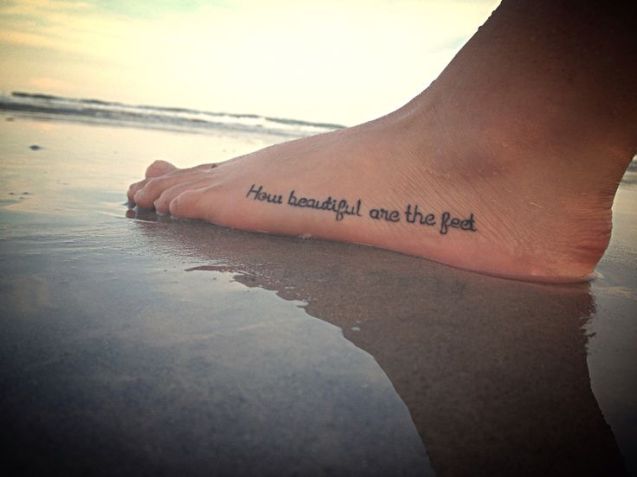
Are YOUR FEET BEAUTIFUL?

When I was in High School, something happened. At some point in my many High School adventures I slashed my left foot, right between the big toe and the second toe.  At the time, it must not have been major, because I don’t really remember what I did and didn’t even apply any medication to it.  I just left it to heal on it’s own.  Needless to say, this place on my foot eventually developed into a cyst that looked like I was creating my own little skin foothill to say the least.  Days turned to months, months turned into years, and I learned to live with this little bump on my left foot, but NEVER liked to show it off.  The great thing about socks and shoes in our society is that I didn’t have to really worry about anything until summer time rolled around.  Oh yea… Summer!  You know the time where you go barefoot and wear your flip flops or chacos or sandals and SHOW OFF YOUR FEET.  You get the picture.  I didn’t think my feet were up to par and really never thought my feet could ever be BEAUTIFUL.  (Hey, I’m a guy, so don’t just tell me to go get a pedicure and be done, girls.  I am sure that if I did consider something like a pedicure, that the lady person would have taken one look at my feet and bursted out in some sort of horrible scream, like the wicked witch of the East did in the Wizard of Oz.)

In a world of feet and stinkiness, I realize that maybe there are some of you out there with me.  You don’t like your feet.  They stink.  They are ugly in some way, and most of all, they CANNOT be BEAUTIFUL.  Lets face it, if there were some chart out there on the interwebs, the value for feet in this world would probably be really low compared to the value for, let’s just say, your eyes.

In conclusion, I realized that my feet were not beautiful and many others did not really have a high value for feet as well.

This is a problem.  When Paul starts talking in Romans about feet.  He uses the word beautiful in the same sentence as feet.  So when he talks all about feet, I naturally reject whatever he is about to say.  It’s like I just skim over Romans 10:15 and get to the next part.

HOWEVER,  all my life, I have been missing something that Paul has been saying about the whole foot thing.

Here is what he says…

And how are they to preach unless they are sent? As it is written, “How beautiful are the feet of those who preach the good news!”
Romans 10:15 ESV


I had to get over the foot stuff and really look deeper into what Paul was saying.  He was pointing out something that makes total sense, to put BEAUTIFUL and FEET in the same sentence.

You see, wayyyyyy back in the day, When armies went to battle, those who remained at home waited anxiously to hear of the outcome, because often their destiny was tied to the success or failure of the armies. But they didn’t have telecommunication systems that could rush news instantly from the battlefront back to the local community. So messages were carried by runners.

Here is the main point – It’s not about FEET it’s about GOOD NEWS

IN FACT, in the ancient world it was customary, in some places, that if the messenger brought bad news, he was punished with death. If it was bad news, then, he would be burdened by the news that he was carrying, and fearful of what treatment he might expect. As each city posted lookouts to watch the approaching runners, it became almost a science whereby the lookout could determine whether the messenger was bringing good news or bad news, just by his feet.

To go deeper into history and the intentionality of Paul, there was the legend of Pheidippides.  (Yell out that name and see what reaction you get!!!) This was a soldier that ran from the battlefield at the site of the town of Marathon, Greece, to Athens in 490 B.C.  He ran so fast and so hard that as he delivered the momentous message “Niki!” (“victory”), he collapsed on the spot and died.  You might have guessed it. That is why we use the word “Marathon” for that long run thing people do.  In fact, Pheidippides was honored by a 24.85 mile run from Marathon Bridge to Olympic Stadium in Athens during the first modern Olympic games held in 1896 in Greece.

Like Pheidippides, if the messenger was bringing good news of victory, his feet would be flying and he would be kicking up a lot of dust. There would be an exuberance and an enthusiasm in his running form, as he approached the walls of the city. Hence the phrase, ‘How beautiful are the feet of those who bring good news!

You See, It’s not about FEET it’s about GOOD NEWS

So when you are grossed out by stinky feet or huge cysts growing on them, remember that Beautiful Feet are ones of Victory. Oh, and by the way, I eventually got a wife, and told her about the cyst, and she made me better by taking me to the skin Dr. and getting it removed on the operation table in the office, as my two young kids ate their Cheerios and watched their Daddy wrench in pain.  I love my wife!

How about you right now? Do you  have Victorious or Defeated feet when it comes to your walk with Jesus?

Wherever your feet go, do they gladly bring the Good News of Jesus Christ?

OR do they bring other news and drag behind you?

How can your pursuit of Christ be like Pheidippides?

Do you want to go run a Marathon now?  (Me Neither)

How do you prepare for the storm?

Alert!!! Alert!!! The storm is coming!

harvey-1-rt-er-170825_12x5_992In the midst of Hurricane Harvey, we rush to fill up our cars with fuel, we rush to fill up our grocery baskets with dry goods, and we rush to batten down the hatches as winds rage and rains fall.


In the midst of all this rushing around, I was brought back to the imagery that Jesus portrayed in Matthew chapter 7.

“Everyone then who hears these words of mine and does them will be like a wise man who built his house on the rock. And the rain fell, and the floods came, and the winds blew and beat on that house, but it did not fall, because it had been founded on the rock. And everyone who hears these words of mine and does not do them will be like a foolish man who built his house on the sand. And the rain fell, and the floods came, and the winds blew and beat against that house, and it fell, and great was the fall of it.”
Matthew 7:24‭-‬27 ESV

How can we THINK TWICE about all this chaos to prepare for the storm?

The truth is that the rushing winds, the falling rains, and the flood waters impact us all, the wise and the foolish.

However, the wise have been practicing Godly Wisdom, building on the foundation of the words of Jesus, and taking those truths into their daily lives.

We have already seen devestation as the eye of the storm has navigated from the coast to the southern Texas region. Those who decided to prepare a firm foundation still take a hit, but remain useful and even a shelter for others that were pummeled by the storm.

Father, help us to see your vision and walk in your wisdom, so that when the storms come, we can be a witness and shelter to others for your Glory.


Are you afraid of Middle School Students?

Help! My Volunteers are Afraid of Students

Doug Franklin’s blog speaks of a key factor for any Student Ministry, and it is something that I know works… RELATIIONSHIPS

Check out the post here

By Doug Franklin March 9, 2017

The key to speaking into students’ lives is to build relationships with them. I tell our staff all the time, “Be a leader worth following.” Leaders worth following build relationships based on one goal: seeing a student grow closer to the Lord. Relationships can start out fun and crazy, but they need to have a goal, a point when the youth worker asks the student to make changes in his or her life based on God’s word. The students will be willing to only if youth workers have taken the time to invest in them.

Relationship building comes easy for many youth workers—it’s why we got into the ministry. We have a passion for students. But your volunteers may not come by it as easily as you do. Training volunteers is tough. Many of them have a heart for service but are afraid of students. Here are some of the techniques I teach my own staff.

Make Time

Students have to get your time if you’re going to get their hearts. Find out what they like to do and do it with them. It’s best if you can find an activity that you both enjoy. Sit where students sit. Be around them, hang out in their world, and they will want to know why you are there.

“Students have to get your time if you’re going to get their hearts.”

Discover a Student

Students are just waiting to be discovered. They want someone to unmask them and bring them out. When you discover them, they’ll give you their heart. At LeaderTreks our staff play a game called 100 questions. Whenever they spend time with students working, doing dishes, or just hanging out, they ask students questions designed to uncover who they are. The game is simple. You start by asking a question about the clothes they are wearing and continue to ask questions based on their answers. The idea is to catch them off guard. They are always willing to talk about clothes or school, but before they know it, they are answering questions about their parents and their relationship with Jesus Christ. The 100 questions game is not a flashy or new idea, but it will do the job of discovering a student.

Write Notes

Writing notes is the most powerful way of making a shallow relationship deeper. When I was a youth pastor, I would try to write six notes a day. Sounds like a lot, but I could do it in 15 minutes. I kept the body of the note the same and changed words to fit the student. Every letter started with “I was praying for you today.” Then I would tell the student what I prayed. If I had seen them in a game or a play, I would mention that. But each letter was short. The power of the note is in how it’s delivered. Many times I would put notes in their cars or on their windshields. If I could, I would find a way to get the notes in their lockers. The best way to deliver a letter is in a place where it is least expected. I have a youth pastor buddy who would take sick bags from planes and write notes on them and put them in the mail. He would often write, “I was sick about you missing youth group.” The postman would always deliver them!

Have a Purpose for the Relationship

Once you have developed a relationship with a student, never lose sight of the mission. Always use your conversations to challenge students to grow. Move the discussion to points of decisions. Ask students to make changes in their lives. Ask them if you can hold them accountable. Never lose your focus on growing the student.

The biggest mistake I see youth workers making is they think they know a student because they know the student’s other siblings or the student’s family. Don’t fall into this trap. Make sure you have spent the time to know each student with whom you have influence. You will demonstrate to them that the program is not about you but about them. Once you have their hearts you will be able to challenge them with whatever God puts in your heart.

Doug Franklin

About the Author

Doug Franklin

Doug Franklin is the president of LeaderTreks, an innovative leadership development organization focusing on students and youth workers. Doug and his wife, Angie, live in West Chicago, Illinois. They don’t have any kids, but they have a dog that thinks he is their only child. Diesel is a 70-pound Weimaraner  who never leaves their side. Doug grew […]

The Other Person Your Child Needs

thinkstockphotos-487918287-1280x640

Posted by | , ,

We’re miles apart connected through cell phones, but the smile I feel in her voice sinks into my bones. With me, through moves across the country, career changes, moments when I was feeling sorry for myself, and times I needed to celebrate, Sibyl always had the words that hit the spot. She’s never shied away from saying what was hard  (she once told me to get off my butt and get started). But her words mattered because they were spoken from someone who knew me and loved me.

We know as adults we need these voices in our lives, but there’s someone who needs them even more: your child.

Wait a minute, your child has you, right? You’re the awesome parent who loves them more than anyone else in the world.

Exactly. You see your child through parent eyes, filled with hope and an achingly deep love that wants them to always try their best, always step into that next opportunity, always get that A, because you know they can do it. You were there the moment they made their grand entrance. You’re the one with the naked baby butt stories they beg you not to tell.

No way can an outside voice ever take your place, but they can fill a different seat at the table that you can’t.

Let’s face it. Somewhere between Lululemon and man buns, you’ve lost your coolness (okay, you haven’t lost it, you just can’t find it at the moment). You’re still essential, but now, there’s more your child needs. They need an additional, I-know-what-you’re-feeling voice. Here’s why:

They need a listening ear that’s not you, because sometimes it’s about you. Geesh, I don’t want my child talking to someone else about me! Actually, you do. Remember that time you made your daughter march back to her room (okay, she stomped) because the shorts she had on didn’t cover the essentials? She felt like you had ruined her life. When she talks to her friends about it, they’re on her side, which isn’t always helpful. When she talks to another wise adult she trusts, they can help with the why behind the what and help her see you’re on her side too. Which is incredibly helpful.

They need someone to sit with them at ground zero. As parents, we want to get them past what hurts and help lift their eyes to tomorrow. But when something hurts, it hurts today. Your child needs someone to talk to that remembers what it feels like to sit at the lunch table alone, left out of the Friday night party, or dumped by their best friend. As parents, it’s tempting to talk them out of feeling sad. It’s okay, there are lots of other parties. But often, they are not ready for this conversation yet. This is where an outside person can “sit in it” with them and help them process their feelings, giving them time for perspective to seep in.

Some things are too itchy for a parent’s ears. We want our kids to talk to us about the hard stuff. Pornography, sexting, what their best friend got arrested for last night, that decision they made that turned out to be a terrible one. But this is where an outside person can be extremely valuable. They can listen without freaking out, bring some wise words and help your child see why they do need to share it with you. A wise outside voice they trust who also reinforces your family relationship and your family values is like gold, and it keeps your child from feeling isolated with things that feel too big to talk about.

If your child already has someone they can talk to that you trust, like a teacher, coach, small group leader, mentor, let your child know you’re okay with it. Be supportive of their conversations, letting them know they can share what they talk about, but don’t force it. And honor the relationship by allowing time for it.

But what if your child doesn’t have an outside voice?

Ask a leader in your church or at their school if there are any young adults they know well who may already be volunteering and would be willing to mentor or be a big brother or sister. Relationship is key here, so make sure it’s someone your kid can connect with.

If your church has small groups for children and students, encourage your child to join. Remember, that other voice doesn’t always have to be one on one. Sitting in a group of kids the same age with a great leader can be an incredible start.

Wherever you find the other person your child needs, get to know them, invite them to have coffee, and thank them for investing in your child.

Check out more Parent Cue Posts here