Peace – Colossians 3:15

As we move further away from Thanksgiving and inch closer to Christmas, thoughts of thankfulness and peace can sometimes be replaced with lists of wants and needs. Instead of being grateful for what we have, we can fall into the trap of comparing and focusing on what we don’t have. When thanksgiving is replaced with thoughts of what we are getting, it can build walls in our hearts in our relationships with God and others. This week, brainstorm with your small group some ways you can come togethe

Peace

Relationships, especially the peaceful ones, take work. This is why the writer of Hebrews tells us to make every effort to live in peace with others. Don’t worry if it doesn’t seem to work the way you’d hoped it would right away. God promises that the effort you take to live in peace will not be wasted. Today, think through how you will respond to others in order to live in peace. Ask God to help you take a step towards peace in even your most difficult relationships.

Tis the Season Devo

Christmas is a season often overflowing from the start. From big dinners and class parties to church services and over-packed schedules, it’s often the busiest season of the year! While this season can be filled with good things, it can also be a time full of so much busyness that it threatens to steal our hope and peace. This week, instead of over-filling your plate and schedule, take the time to fill your heart with God’s Word. Start by memorizing this verse so you don’t miss the peace and hope the Christmas season has to offer.

Advent Calendar for Your Family!

Every good and perfect gift comes from God. In fact, His most perfect gift was His only Son, Jesus.

Gather your family and continue reading the story of Christmas one day at a time using the Advent Calendar.

The Scripture and prompts will take your family on a journey to generosity, leading you to appreciate the season together in a whole new way.

Click on the Downloads Below.

AdventCalendar_8_5x11_2017

AdventCalendar_11x17_2017

AdventCalendar_Multi_2017

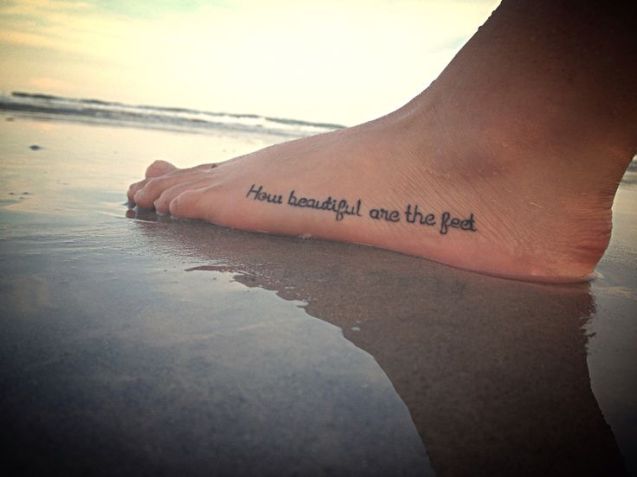
Are YOUR FEET BEAUTIFUL?

When I was in High School, something happened. At some point in my many High School adventures I slashed my left foot, right between the big toe and the second toe.  At the time, it must not have been major, because I don’t really remember what I did and didn’t even apply any medication to it.  I just left it to heal on it’s own.  Needless to say, this place on my foot eventually developed into a cyst that looked like I was creating my own little skin foothill to say the least.  Days turned to months, months turned into years, and I learned to live with this little bump on my left foot, but NEVER liked to show it off.  The great thing about socks and shoes in our society is that I didn’t have to really worry about anything until summer time rolled around.  Oh yea… Summer!  You know the time where you go barefoot and wear your flip flops or chacos or sandals and SHOW OFF YOUR FEET.  You get the picture.  I didn’t think my feet were up to par and really never thought my feet could ever be BEAUTIFUL.  (Hey, I’m a guy, so don’t just tell me to go get a pedicure and be done, girls.  I am sure that if I did consider something like a pedicure, that the lady person would have taken one look at my feet and bursted out in some sort of horrible scream, like the wicked witch of the East did in the Wizard of Oz.)

In a world of feet and stinkiness, I realize that maybe there are some of you out there with me.  You don’t like your feet.  They stink.  They are ugly in some way, and most of all, they CANNOT be BEAUTIFUL.  Lets face it, if there were some chart out there on the interwebs, the value for feet in this world would probably be really low compared to the value for, let’s just say, your eyes.

In conclusion, I realized that my feet were not beautiful and many others did not really have a high value for feet as well.

This is a problem.  When Paul starts talking in Romans about feet.  He uses the word beautiful in the same sentence as feet.  So when he talks all about feet, I naturally reject whatever he is about to say.  It’s like I just skim over Romans 10:15 and get to the next part.

HOWEVER,  all my life, I have been missing something that Paul has been saying about the whole foot thing.

Here is what he says…

And how are they to preach unless they are sent? As it is written, “How beautiful are the feet of those who preach the good news!”
Romans 10:15 ESV


I had to get over the foot stuff and really look deeper into what Paul was saying.  He was pointing out something that makes total sense, to put BEAUTIFUL and FEET in the same sentence.

You see, wayyyyyy back in the day, When armies went to battle, those who remained at home waited anxiously to hear of the outcome, because often their destiny was tied to the success or failure of the armies. But they didn’t have telecommunication systems that could rush news instantly from the battlefront back to the local community. So messages were carried by runners.

Here is the main point – It’s not about FEET it’s about GOOD NEWS

IN FACT, in the ancient world it was customary, in some places, that if the messenger brought bad news, he was punished with death. If it was bad news, then, he would be burdened by the news that he was carrying, and fearful of what treatment he might expect. As each city posted lookouts to watch the approaching runners, it became almost a science whereby the lookout could determine whether the messenger was bringing good news or bad news, just by his feet.

To go deeper into history and the intentionality of Paul, there was the legend of Pheidippides.  (Yell out that name and see what reaction you get!!!) This was a soldier that ran from the battlefield at the site of the town of Marathon, Greece, to Athens in 490 B.C.  He ran so fast and so hard that as he delivered the momentous message “Niki!” (“victory”), he collapsed on the spot and died.  You might have guessed it. That is why we use the word “Marathon” for that long run thing people do.  In fact, Pheidippides was honored by a 24.85 mile run from Marathon Bridge to Olympic Stadium in Athens during the first modern Olympic games held in 1896 in Greece.

Like Pheidippides, if the messenger was bringing good news of victory, his feet would be flying and he would be kicking up a lot of dust. There would be an exuberance and an enthusiasm in his running form, as he approached the walls of the city. Hence the phrase, ‘How beautiful are the feet of those who bring good news!

You See, It’s not about FEET it’s about GOOD NEWS

So when you are grossed out by stinky feet or huge cysts growing on them, remember that Beautiful Feet are ones of Victory. Oh, and by the way, I eventually got a wife, and told her about the cyst, and she made me better by taking me to the skin Dr. and getting it removed on the operation table in the office, as my two young kids ate their Cheerios and watched their Daddy wrench in pain.  I love my wife!

How about you right now? Do you  have Victorious or Defeated feet when it comes to your walk with Jesus?

Wherever your feet go, do they gladly bring the Good News of Jesus Christ?

OR do they bring other news and drag behind you?

How can your pursuit of Christ be like Pheidippides?

Do you want to go run a Marathon now?  (Me Neither)

How do you prepare for the storm?

Alert!!! Alert!!! The storm is coming!

harvey-1-rt-er-170825_12x5_992In the midst of Hurricane Harvey, we rush to fill up our cars with fuel, we rush to fill up our grocery baskets with dry goods, and we rush to batten down the hatches as winds rage and rains fall.

In the midst of all this rushing around, I was brought back to the imagery that Jesus portrayed in Matthew chapter 7.

“Everyone then who hears these words of mine and does them will be like a wise man who built his house on the rock. And the rain fell, and the floods came, and the winds blew and beat on that house, but it did not fall, because it had been founded on the rock. And everyone who hears these words of mine and does not do them will be like a foolish man who built his house on the sand. And the rain fell, and the floods came, and the winds blew and beat against that house, and it fell, and great was the fall of it.”
Matthew 7:24‭-‬27 ESV

How can we THINK TWICE about all this chaos to prepare for the storm?

The truth is that the rushing winds, the falling rains, and the flood waters impact us all, the wise and the foolish.

However, the wise have been practicing Godly Wisdom, building on the foundation of the words of Jesus, and taking those truths into their daily lives.

We have already seen devestation as the eye of the storm has navigated from the coast to the southern Texas region. Those who decided to prepare a firm foundation still take a hit, but remain useful and even a shelter for others that were pummeled by the storm.

Father, help us to see your vision and walk in your wisdom, so that when the storms come, we can be a witness and shelter to others for your Glory.


How to Build Lasting Integrity in Kids

Icebergs and Ice Cubes

Check out the growing leaders blog here

An iceberg has been used over and over again by instructors to illustrate hidden realities. We often talk about the “tip of the iceberg” meaning there’s a larger amount of unseen substance than what’s visible. It’s an analogy. The iceberg is one of our most popular Habitude images when we teach leadership to students.

It has everything to do with integrity.

I believe the ten percent that lies above the water line represents our skills. They’re visible. Everyone can see them. But, they’re only the tip of our influence. The 90 percent that lies beneath the surface represents our character. And it’s always what is below the surface that sinks the ship.

Consider the Titanic for a moment. That tragic shipwreck that killed hundreds of people on board wasn’t due to the tip of the iceberg. It was that massive amount that’s invisible. It’s true about most failures in life, as well. I don’t know anyone who’s derailed their life with a technique flaw. I do, however, know several people who’ve derailed their career or their marriage or their friendships due to a character flaw.

When we teach our children character, (whether they’re six or sixteen), we cultivate substance beneath the surface. It can’t be seen, but in the long run it will surely impact the substance and direction of their lives. It’s invisible but important. The fact is, the majority of our influence lies in qualities beneath the surface.

My guess is—you’re a parent who wants to raise your children to be people with integrity. You want them to live by values, to be honest and ethical and to build a solid reputation. It’s a noble goal, but one that’s not easy to achieve today.

Why Is This so Challenging to Develop?

Becoming a person of integrity is difficult because our society places so much emphasis on what we can see. Our talent. Our Facebook profile. Our selfies. Our appearance. It’s almost always about our image not our integrity. If our kids display any special gifts or leadership qualities, it can be doubly hard. Consider these four statements:

  1. Their talent has the potential to carry them further than their character can sustain them. Without direction, their gift can mold them into someone they don’t intend to become. They’ll be tempted to use their gifts to go places their character isn’t robust enough to guide them or keep them aligned with good ethics.
  1. Trouble comes when their integrity doesn’t keep pace with the momentum created by their intelligence. Sometimes our intelligence is much stronger than our character. Our moral intelligence isn’t strong enough to give us clarity to make good choices. Smart kids can rationalize almost any misbehavior or poor decision.
  1. There is no correlation between giftedness and maturity. It’s easy to assume that a talented athlete, student council member or performer must be a mature leader. Not true. A person can have great gifts . . . and be the most immature person in the world. Unfortunately, they can still have influence. We must help our kids see the difference.
  1. Their commitment to integrity can be easily eroded by their love of progress. If a student lacks integrity, it doesn’t mean they’re inherently bad people. It may mean they are leaders and this is pushing them forward. Leaders want to make progress! Because they love progress they can compromise a commitment to integrity.

In addition, we live in a day of pluralism and tolerance, where we’ve taught our children to value and accept all points of view. This is a good thing. Unfortunately, kids can unwittingly fail to distinguish perspectives that are just plain wrong or unethical. The unintended consequence can be that kids fail to develop the ability to discern right from wrong. They don’t want to be judgmental, so they withdraw from making even moral judgments. This inability will be conspicuous as they begin their careers.

What Can You Do?

Let me suggest a handful of action steps you can take with your kids:

1. Make a list of values.

One of the two greatest goals you can model and teach to your children is to help them create a list of 4-6 words that describe the person they hope to become as adults. Call it a list of personal core values. Then, help them find ways to live up to those values weekly.

2. Challenge them to add value to others daily.

Next, in addition to living by values, give them perspective on adding value to others. Help them to perform one act every day that adds value to someone else. Try doing it yourself. Living by values and adding value are what makes people valuable to teams.

3. Make it a game to do what you disdain.

Challenge the family to choose something every week that you each don’t like to do, and do it daily. It may be a chore around the house, like taking out the garbage. Keep score on parents and kids. This creates a habit of doing right—even when it’s no fun.

4. Dinner check ups on integrity.

At dinner, talk about a weekly opportunity each family member had to practice something that displayed integrity when no one was watching. Anonymous acts of character. Affirm any growth in each person.

An Iceberg Not an Ice Cube

These simple acts can begin to cultivate kids with robust character. Kids who grow below the surface. Solid. Stable. Steady. Interestingly, there is such a thing as an iceberg that has very little substance below the surface. It’s called a “whistler.” They have nothing more underwater than what’s above. They’re like a floating ice cube. Do you know how you can identify a “whistler?” They consistently make noise as they drift.

Let’s raise our kids to have substance below the surface.