Teaching Middle Schoolers About God: How to Be More Strategic and Relational

PHASE_Blog_TeachingMSAboutGod

Check out the Just A Phase Blog and Resources here

]Ok, let’s do some math.

More than likely, the average six graders who are coming to your church will actually come less than 50 percent of the time.

That means they’ll likely spend about 25 hours in your church this year.

Of those 25 hours at least 30 percent will be spent:

  • Getting into the room
  • Saying “hi” to friends
  • Playing games
  • Updating social media
  • Saying “bye” to friends

So that means they’ll actually experience less than 20 hours of teaching or small group interaction in a given year.

The reality is that your middle schoolers will use their smartphone more in one week than they will attend your church in one year.

Related: 35 Reasons My Middle Schooler Might Be Freaking Out

So, here’s the question: If you have less than 20 times to connect to a sixth grader this year, what are you going to teach them? How are you going to influence the spiritual direction of the average child or teenager when you only have a few minutes every other week? READ ON

Monday in the Life of a Middle Schooler

MSPhase6web MSPhase7&8web

Check out http://justaphase.com/oc16/monday-in-the-life-of-a-middle-schooler/

Monday in the Life of a Middle Schooler


“You can’t speak the truth in love if you don’t love who you are speaking to.” – Reggie Joiner

EMPATHY BEGINS WHEN WE UNDERSTAND THIS PHASE

What was life like for you as a middle schooler?
What is life like for middle schoolers today?

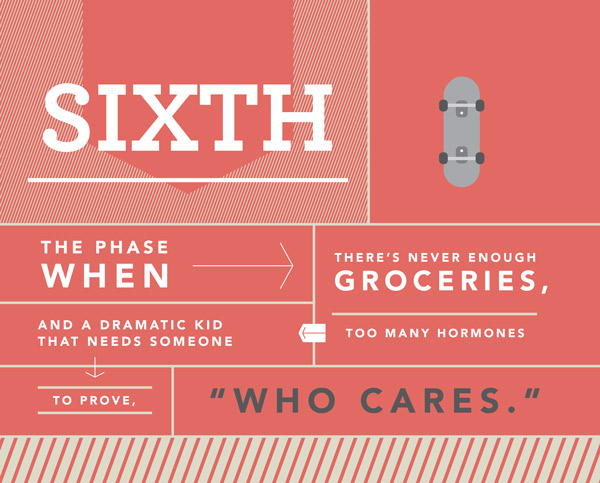
SIXTH GRADE

Crisis: Puberty – the turning point
Questions: Who do I like? Who likes me?
Goal: Provide stability.

SEVENTH/EIGHTH GRADE

Crisis: Self-Awareness – the turning point
Questions: Who am I?
Goal: Help them discover uniqueness.


This is where empathy begins:
knowing and loving our middle schoolers.
And empathy is where influence begins.


Understanding our people helps us minister effectively and maximize our influence.

SINCE MONDAY IS COMING…

We need to affirm their personal journey.

A MIDDLE SCHOOLER IS AFFIRMED WHEN…

  • They are known.
  • They are loved and liked.
  • They are listened to more than they are talked to.
  • They are met at their level.
  • They get quality time with you.

*Affirmation is the fuel a middle schooler needs to face Monday.*

HOW CAN WE EQUIP MIDDLE SCHOOLERS FOR MONDAY?

  • Remind them they belong.
  • Give them Biblical teaching in a relevant way
  • Match them with a leader who will check-in with them during the week
  • Encourage them to lean into their community.
  • Pray for them regularly
  • Give them starting points so they can draw close to Jesus on their own
  • Utilize social media to encourage throughout the week

MONDAY IS COMING….

“For this reason, I kneel before the Father, from whom every family in heaven and on earth derives its name. I pray that out of his glorious riches he may strengthen you with power through his Spirit in your inner being, so that Christ may dwell in your hearts through faith. And I pray that you, being rooted and established in love, may have power, together with all the Lord’s holy people, to grasp how wide and long and high and deep is the love of Christ, and to know this love that surpasses knowledge—that you may be filled to the measure of all the fullness of God.” – Ephesians 3:14-19

KATIE EDWARDS
Middle School Pastor at Saddleback Church
Twitter | Instagram

What the Pope & Instagram Teach Us About Connecting with Students

Check out the Article Web Page Here

I’m sure the headline above appears a bit random. Is there really a common denominator between the Pope and Instagram co-founder Kevin Systrom?

Apparently, there is.

About a month ago, Instagram’s CEO and co-founder Kevin Systrom met with Pope Francis at the Vatican for the very first time. You already know, not everyone gets an audience with the Pope. What was the purpose of their meeting?

They met to discuss the power of images.

Instagram is now the fastest growing platform for social media sharing among the younger population, passing up Facebook from just a few years ago. Facebook remains the largest social media site, but it’s significant that they were smart enough to buy Instagram, foreseeing the trend toward posting and sending images over words. Systrom asserts they intend for Instagram to be the “dominant platform for visual communication.”

So, let’s listen in on the conversation between the Pope and Kevin Sysyrom. There were at least three realities that emerged as they conversed that we can integrate as we teach and lead students:

What Pope Francis and Kevin Systrom Reveal About the Power of Images:


pope-francis-707395_1280-371x278

Images unite generations and cultures.

This is literally what Kevin Systrom said to TIME magazine, which reported the meeting between the two leaders. Here were two men—one corporate, one sacred—connecting over a curated set of pictures that Systrom brought with him. He suggested that images unite people from different ages, different cultures and across all borders. Just think about international traffic signs. We’ve gone to images or icons because we all recognize their meaning, regardless of our language or culture. These images bring people together.

Images can tell stories in real time.

The set of images Kevin brought to Pope Francis told the stories of recent tragedies that people from all over the world had endured—pictures from the exodus of immigrants from Syria to Europe, to the Nepalese earthquake and its aftermath. In a picture, we can unveil so much without even saying a word. Images become the language. I remember pictures from history that connected me to the story of my country, and the narrative of my past.

Images reveal truth.

Finally, images can communicate a truth, whether it’s simple and straightforward, such as the trending photos of Taylor Swift’s 1989 tour., Or they can communicate pain—like the aftermath of the terrorist attack in Brussels, Belgium. They can also communicate hope —like the images of so many who are aiding refuges internationally. Images have the power to make us laugh or learn. Through symbolism, images often represent a truth or remind the viewer of an important axiom. And because they’re a metaphor—they’re disarming, even as they teach.

So What Do I Do with This Information?

These are but a handful of reasons I chose over the years to leverage images and narratives to teach leadership and life skills. They engage both the head and the heart—both hemispheres of the brain. Images make you think and feel at the same time. Each of our images, called Habitudes® (images that form leadership habits and attitudes), actually represent a timeless truth we believe the young must learn in order to lead themselves and others well. Since 2004, when we published the first Habitudes book, it’s been remarkable to see how memorable they are once students learn the truth that is captured in the image. I just spoke to a thirty year old who learned some of the Habitudes images back in college, a decade ago. She still remembers and uses them to this day.

So how do images impact our everyday lives?

If you’re communicating with colleagues, a study done by Social Bakers last year exposed the visual nature of social networking. The study indicated that photos trump the market on Facebook, making up 93 percent of the social network’s most engaging posts.

Research from Skyword found that when you’re sending a message—if your content includes compelling images, you can average 94 percent more views than your boring counterparts. Our eyes are drawn to visuals.

If you’re looking to get your message noticed on-line, a study done with Google+ users  revealed that images play a role in providing visual cues to grab someone’s attention on-line. Researchers found that a post on Google+ was three times more likely to be re-shared if it included an image.

So, what are we waiting for? It’s time we include images as we communicate. Get the picture?

– See more at: http://growingleaders.com/blog/pope-instagram-teach-us-connecting-students/#sthash.RQjUEPcx.dpuf

Generation iY – Tim Elmore

Source: Generation iY – Tim Elmore

One of the most significant discoveries researchers have made on both Millennials and Generation Z (kids growing up since the dawn of the 21st century) is that they have been conditioned to fear failure. Some kids are so paralyzed by the thought of failing, they’ll do anything to avoid it:

  • Quit the team.
  • Cheat on a test.
  • Lie about their results.
  • Never try in the first place.

According to one study, conducted by Bilkent University in Turkey, this fear of failure has gone global in 21st century students. The study found that the “fear of failure at school can negatively affect a student’s motivation and attitude to learn.”

The researchers asked over 1,000 high school and college students to complete surveys about their motivation to learn and the strategies they employed. In the end, they discovered that kids who feared failure at an early age were more likely to create goals to validate their ego rather than help them grow and develop. These students were also less likely to utilize “effective learning strategies” and “more likely to cheat.”

Ouch. Did anyone see this coming?

In 2003, research performed by Wiley Periodicals noted that one of three psychological variables that hinder adolescents’ levels of school engagement was the fear of failure. Hmmm. I think I see a pattern here.

The Golden Gate Paradox

golden-gate-bridge-1081782_1280-417x278

There is a great story that informs how we should lead students through this awful fear and liberate them from it. (I share it in my book, Twelve Huge Mistakes Parents Can Avoid.) In 1933, when the Golden Gate Bridge was being built, the crew fell behind on their deadlines. One of the workers had fallen to his death causing his colleagues to work more slowly each day for fear it might happen again. Finally, one worker approached the supervisor and asked if a net could be placed underneath the men to prevent them from dying if they fell. The supervisor was apprehensive to take the time to do this because they were already behind schedule. But, alas, he agreed and a net was hoisted into position. Suddenly, the men worked faster and more efficiently—actually speeding up the completion of the bridge. What enabled them to work faster and better? Removing the fear of failure. Suddenly, it was safe to try what they had feared before.

I call this the Golden Gate Paradox. Once the workers were liberated from the fear of failure—they could fall without fatality—they worked and succeeded better than ever. And faster then ever. Without the fear of failure, they failed less. The bridge was finished. The foreman met his deadline. The workers were safe. Everyone won.

In the end, people (especially students) need safety nets in order for them to welcome failure as part of the learning process. Safety nets are:

  • Motivating. (They want to jump in, take risks and initiate action.)
  • Liberating. (They feel free to explore, learn and grow without worry.)

What makes this “safety net” act challenging for staff and faculty is removing student’s fear of failure without neglecting to teach the reality of consequences. In other words, far too often we adults have rescued students from their failures, and they never learn to navigate or face the consequences for their mistakes.

Leaders must be dispensers of grace, allowing followers to fail forward, and not quit or flunk out when mistakes are made. This actually enables them to succeed more often and more quickly. However, leaders must also condition followers to weigh out the ramifications for their decisions and actions. So we must balance both:

  • Safety (It’s OK to fail as you learn).
  • Reality (Every action has an outcome).

Suggestions for Safety Nets

Here are some ideas you can tweak to perform the Golden Gate Paradox:

  1. Start by telling stories of your failures, without celebrating them. Liberate the students by revealing that you failed at some past ventures and lived to tell about it. In fact, you learned.
  2. Communicate the boundaries for their mistakes and don’t remove every consequence. Ease them into the new scenario; let them push the envelope.
  3. Host a course called “Failure 101.” More than one school has initiated such a class especially for students who fear it. It’s all about learning from failure.
  4. When possible, offer second chances for fearful students. Many adults are so angry at Gen iY kids, they remove all second chances. This is ultimately harmful.
  5. Gradually, condition them to welcome failure as part of their learning. Expose them to responsibility as they gain more autonomy. These two go together.
  6. Find out what they fear the most and address it. Perhaps they fear looking bad or disappointing mom. Once you help them identify it, address the cause.

Let’s hoist some safety nets and watch our students flourish.

– See more at: http://growingleaders.com/blog/category/generation-iy/#sthash.6BSOqUpA.dpuf

Risen Movie shares a new angle on the Resurrection Story

Risen Movie shares a new angle on the Resurrection Story

Sometimes we can look at the same story and pass it off as “routine.”  Risen takes you to a whole new angle of a story that could have happened.  I enjoyed it as entertainment, along with an impacting and uplifting story that gave me something to think about as we approach Easter.

FROM ‘THE PASSION OF THE CHRIST’ TO ‘RISEN’ WITH THE EDITORFilm Editor Steven Mirkovich knows how to create impact through films. With the critically acclaimed THE PASSION OF THE CHRIST film under his belt, Mirkovich was well prepared to tackle the editing of the new faith film RISEN, which is in theaters everywhere.”Whether you’re religious or not, it doesn’t matter with this film, because it’s an uplifting story that makes you feel hopeful. It’s a film that everyone should see,” said Mirkovich.

Watch as Mirkovich discusses the challenges of cutting down hundreds of hours of footage to create an inspirational portrayal of the impact that resulted from Christ’s life, death, and resurrection.


YouTubeYouCanUse: The Price is Wrong

The Price is Wrong

Video Link

https://www.youtube.com/watch?v=s0ItTbwo2Tc

Topic

Consequences, Game Show, Mistakes, Prize, Winning

Bible Verse(s)

1 John 1:9

Discussion Starter

We’ve all done it. In an instant we’ve done the one thing we weren’t supposed to do for the whole world to see.

In this case, Manuela gave a contestant on The Price is Right a brand new car when she wasn’t supposed to, which is awesome. But in our case our mistake might not be so awesome.

The Bible says that we all make mistakes, we all sin. (Romans 3:23) But the good news is that that Jesus offers forgiveness, even when we sin accidentally. “If we confess our sins, he is faithful and just to forgive us our sins and to cleanse us from all unrighteousness.” (1 John 1:9)

3 Questions

1. When was a time you messed up but it turned out great?
2. Would you rather win a $20,000 car or $10,000 in cash?
3. Is it easier for you to notice your own mistakes or mistakes in others? Why?

Chew on this

Is there a difference between an intentional and accidental sin in God’s eyes?

What We Learn About God from The Force

SoulFuel

What We Learn About God from The Force

A long time ago in a movie theater far, far away…

I went to see the original Star Wars movie. I was a young kid at the time, but in retrospect it has become one of my most cherished memories. Up until the unveiling of this film, the whole genre of fantasy/science-fiction/adventure was a veritable wasteland of cheesy endeavors that made you want a refund.

Ah, but in Star Wars we have an opening scene with a rebel ship being pursued and fired upon by an Imperial Battle Cruiser, and from that moment on, your eyes and senses are glued to this fantastic universe where good battles evil in the context of The Force.

“There is a God and there is a good and bad side.”—George Lucas

Now, 38 years later (like I said…a long time ago), one of the biggest movie release perhaps in the history of the celluloid industry is The Force Awakens. A whole new generation of Star Wars aficionados will be generated, and we will anxiously anticipate the final two installments of this immortal series.

But in the meantime, have you ever thought about what we can learn about God from The Force? Many may quickly dismiss even considering this possibility, but I would like to offer a few thoughts that might alter that perception.

First, if you look deep enough into the dialogue of the series, there are some really cool parallels with Biblical truth. For example:

Luke Skywalker: May The Force be with you.
The Bible: May the Lord be with you.

Obi-Wan: The Force will be with you…always
Jesus: And remember, I am with you always, to the end of the age (Matthew 28:20).

Watching and reflecting on Star Wars through the years, and particularly focusing on the constant and abiding presence of The Force has been an ongoing reminder of the great truth that God will never leave us or forsake us.

Still, there are some stark and significant differences. One of these is the personal nature of the God of the Bible vs. the impersonal nature of The Force. By this I mean that it is one thing to be comforted by a Force that “surrounds us and binds us together,” but it is a much greater and more profound thing to know that our Triune God indwells our hearts through the Holy Spirit, and because of that, we are never abandoned or alone in this world.

Here’s the way King David expressed this certainty:

God, investigate my life;
get all the facts firsthand.
I’m an open book to you;
even from a distance, you know what I’m thinking.
You know when I leave and when I get back;
I’m never out of your sight.
You know everything I’m going to say
before I start the first sentence.
I look behind me and you’re there,
then up ahead and you’re there, too—
your reassuring presence, coming and going.
This is too much, too wonderful—
I can’t take it all in!

Is there anyplace I can go to avoid your Spirit?
to be out of your sight?
If I climb to the sky, you’re there!
If I go underground, you’re there!
If I flew on morning’s wings
to the far western horizon,
You’d find me in a minute—
you’re already there waiting!
Then I said to myself, “Oh, he even sees me in the dark!
At night I’m immersed in the light!”
It’s a fact: darkness isn’t dark to you;
night and day, darkness and light, they’re all the same to you
(Psalm 139:1-12, The Message).

Our Triune God indwells our hearts and because of that, we are never alone in this world.

And speaking of dark and light, that is the other critical reality that the Star Wars series has brought to center stage. That’s why George Lucas made this statement: “All I was trying to say in a very simple and straightforward way is that there is a God and there is a good and bad side” (Source: Cinema & New Media Arts). One of his motivations in making the Star Wars series was to counter the pervasive morally relativistic thinking of that generation—which obviously is still alive and well in the 21st century.

And the Bible makes it very clear that there is a “good side and bad side” as well, and you are either engaged in one or the other at all times. Check out Jesus’ words to the Apostle Paul on the road to Damascus:

“I’m sending you off to open the eyes of the outsiders so they can see the difference between dark and light, and choose light, see the difference between Satan and God, and choose God. I’m sending you off to present my offer of sins forgiven, and a place in the family, inviting them into the company of those who begin real living by believing in me” (Acts 26:17-18, The Message).

I hope you enjoy The Force Awakens. But even more so, I hope you realize that we have a God who is with us…always. And we fight in an intense battle between darkness and light. So as you step out of the theater, step into the very real storyline that makes a very real difference both for now and into eternity!

Flashpoint: Ignite Into Action

This week, reflect on the truth that the Holy Spirit indwells your heart so that you can be aware of God’s presence and full of His power to follow His will. Keep your eyes open to the battle around you, and live like a Christian Jedi!

Accelerant: Fuel for THE Cause

Pray: Father, thank You for Your constant love and abiding presence. Empower us to open the eyes of our friends so they can enter into a relationship with You. In Jesus’ name, amen.

Read: 1 Peter 2:9.  But you are not like that, for you are a chosen people. You are royal priests, a holy nation, God’s very own possession. As a result, you can show others the goodness of God, for he called you out of the darkness into his wonderful light (NLT).

Get: “The Holy Spirit’s P.A.C.T.” The Holy Spirit is NOT an impersonal “Force.” He’s a Person! Pick up this convenient, low cost downloadable Youth Group 2 Go lesson from Dare 2 Share on the role of the Holy Spirit in every believer’s life.

Five Ways Gaming Is Changing Our World

Five Ways Gaming Is Changing Our World

Today we hear from Andrew McPeak again. Andrew is a writer, curriculum designer, and speaker who has served with a number of non-profit organizations (and has spoken to thousands of Millennials) over the last 5 years and now serves on our team at Growing Leaders. Today, Andrew offers his insights on how gaming has changed our world and how adults can respond. We think you will love his insight. You’ll be hearing from him on blogs and in our resources from time to time. Enjoy.

Every young person goes through a proving moment in life; it’s that opportunity when they make their first “adult” decision. I call them “adult decisions” because they come when you realize that you can make whatever choice you want, and you will be the only one ultimately responsible for the consequences of your decision. Sometimes it’s a defining moment. I remember my first decision of this kind clear as day. It wasn’t picking what college I was going to attend, breaking up with a girlfriend, or even some part of learning to live on my own. My moment was the day I decided to sell my Xbox 360 the summer after I graduated from high school, instead of taking it with me to college.

I had plenty of friends that took their gaming consules, but I knew that, with my slightly addictive personality, I wouldn’t be able to handle it. That summer, I noticed that I had played a new game (just ONE game) for over 70 hours in my free time. I poured hours upon hours into that game and at the end, when I realized how much I had given to this artificial world, I asked myself, “What was it all for?” I didn’t have a good answer to that question, and it’s left me fascinated with the gaming industry ever since. As a writer now, I spend more time watching the industry, looking at those who have been unable to (or even consciously decided not to) make the same decision that I did. Overtime, gaming culture has continued to grow, somehow under the radar of most thinkers, leaders, and authors over 30, and that’s why we’re talking about it here.

Five Ways Gaming is Changing our World

gaming

Somehow without us really noticing it, gaming has become HUGE. A couple years ago, for the League of Legends final (currently the world’s most popular video game) in South Korea, more people tuned in around the world to watch than did the NBA finals of the same year. In 2014, upon the release of the highly anticipated console game “Destiny”, developers sold a rumored 10-12 million copies of the game within the first 24 hours of it’s release, making the game’s creators more than $500 million literally overnight. This made “Destiny” the largest release of any form of media ever, more than doubling any releases from the music and movie industries the same year. But while musicians and movie stars often make the front covers of our magazines, the celebrities of the gaming industry continue to make their millions under the radar… at least in America.

So how is this hidden behemoth changing the world around us? Let me give you a few insights:

  • Everyone is Playing

97% of teens play video games every single week and 50% of teens 12-17 admit to playing games “yesterday”. Not only that, but 38% of all teen boys share their gaming handle when first meeting someone they want to be friends with, a Pew survey found. Gaming is on the periphery of culture now, but its influence will take center stage in the next decade.

  • Growing Female Participation in Games

Games are played mostly by males, but in the youngest demographics, females are gaming more and more often. There are also an increasing number of games that are made specifically for female consumers.

  • Your Kids Could Literally Make a Career out of Gaming

Apart from just the development of games, gaming has generated a number of lucrative ‘sub-industries,’ which include Conferences, Cosplay, Game-casting, Team Merchandizing, “YouTube-ing”, and more. The most culturally significant impact of all of this? You can literally make a career out of gaming, even if you don’t play! At Growing Leaders, we know recent graduates who have gotten a tech degree and immediately moved to Silicon Valley to create games. And they make great money too!

  • Mobile Gaming is the Wave of the Future

While console and computer games are huge, the largest and most profitable form of gaming is mobile, a type of gaming played by almost every demographic in the western world. Whether Tetris or Candy Crush, almost everyone (grandparents included) is helping give rise to the growth of the mobile gaming industry.

  • New Celebrities

Gaming has created a new group of celebrities that your kids probably already know. Some of them are players, others are YouTube creators, and still others are marketers, riding the wave of gaming popularity. It’s probable that, in the near future, these gamers will be on the covers of magazines that once only held professional athletes.

The Games We’re Playing

If you think that gaming in America has reached a troubling level then you may be starting to ask the question, where is this gaming shift taking us? There is an answer to this question for us in the robust gaming culture of South Korea. In South Korea, gaming celebrities are as popular as sports stars and young men and women are starting to show signs of gaming addiction. While the U.S. has yet to recognize gaming as a possible subject of clinical addiction, South Korea has gone so far as to create laws banning underage gamers from playing past midnight, and building health facilities specifically dedicated to helping to resolve internet addiction. If you have the chance to view about five minutes of this YouTube documentary it will give you some fascinating insights into the problems that could be in our future.

On top of that documentary, here are other suggestions on how to remain familiar with the changes coming to our world through the gaming industry:

  1. Talk to your kids or students about which games they are playing and review those online.
  2. Check out what’s happening on sites that show live gaming like twitch.com or gaming.youtube.com.
  3. Read this article from the Guardian about 16 gaming trends. Its’ fascinating!

When it comes to gaming, there is a lot to be fascinated about, if you’re into that sort of thing. Sadly, there is a lot to be worried about as well. Studies show that heavy gaming can slow the development of morality within young men. Gaming is also changing the norm of social interactions, especially among young men as most of their friendships are maintained by gaming together as opposed to physical interactions. And perhaps most concerningly, as the number of heavy gamers increases, there is a growing trend towards a cultural acceptance of wasting large amounts of time consuming media via gaming or binge-watching television. These changes are a part of a culture shift that we must be watching carefully. If we don’t we are, ironically, playing games with our future.


Generation Z… The Homelander Generation

Generation Z represents the batch of students born after 2001.  This means YOUR MIDDLE SCHOOLER!

Find out what research is saying about who they are… as well as how we can lead them.

  1. Instant Access – Google Reflex =look things up immediately and instantly
  2. New Normal – Growing Up in Post 911 age with terrorism as common place, along with the current racial unrest, economic low and uncertainty in their world.
  3. On Demand – Netflix, Hulu, Watch and entertain NOW, instead of waiting later
  4. Multicultural – 50% increase in mixed ethnic races

Check out More Tim Elmore Videos Here

the 62 Worst and Weirdest Nativities (the 2015 revised list!) | whyismarko

Slide1-copy

MARKO is a Youth Ministry GURU and also specialist in finding the WORST or WEIRDEST NATIVITIES!

Yup, I’ve seen the Coke can nativity. And I’ve seen the one with the pack of Camel cigs. And the live dogs posed as a nativity. And, yeah, the many glorious combinations of Barbies and Godzillas and just about everything else. But they’re not on my list of the XX Worst and Weirdest Nativities. That’s…

Source: the 62 Worst and Weirdest Nativities (the 2015 revised list!) | whyismarko