Why We Can’t Ignore the Lowest Birthrates in US History

Why We Can’t Ignore the Lowest Birthrates in US History

Do you know the current birth rate in America today? The U.S. fertility rate fell to the lowest point since record keeping started more than a century ago, according to statistics from the Centers for Disease Control and Prevention.

That’s almost unbelievable.

In 1909, the government began keeping track of what’s called the fertility rate. The general fertility rate is the number of births out of 1,000 women between the ages of 15 to 44. The U.S. birth rate dipped in 2011 to the lowest ever recorded, led by a plunge in births to immigrant women since the onset of the Great Recession. According to CNN, the first three months of 2016 saw fertility rate in the U.S. fall to its lowest level; 59.8 births per 1,000 women.

While this trend is intriguing, I just read the latest statistic, which stopped me in my tracks.

As of last month, August 2016, America had the lowest birth rate of any point in recorded history. Lower than the Seniors, the Builder Generation, the Baby Boomers, Generation X or the Millennials. Women are choosing something other than raising children as a path to the life they want.

What Does This Mean?

Family

There has been a real shift in our view of children and parenting over the last decade. The Millennial Generation is the largest generation in U.S. history, at 80 million strong. (They’re young adults today). Right in the middle of their generation, more children were born in America in 1991 than any other year in recorded history. Today, however, we’ve swung to our lowest fertility and birth rates—just as the largest generation in history steps into the typical age of parenting.

So, why are we not having kids?

1. Women are choosing careers over kids.

Millions of families now believe they cannot enjoy the standard of living they want without two incomes in the home. Additionally, many women would say they enjoy a career more than they’d enjoy raising a child—and it’s tough to do both.

2. The economy often restricts couples from having children.

Sometimes the choice not to have children (or to have less children) is not just about the desire for an affluent standard of living. Some couples would say they simply cannot afford to bring another person into their family and provide for them.

3. Many are choosing a single life, instead of a family.

I’ve written before on the growing number of people living and dining alone. While this may lead to lots of new realities, one certain reality is the difficulty of having a child in the home with no caring adult to raise it. Hence, fewer kids.

4. Parenting children is, perhaps, the most taxing task an adult can do.

Parenting is not for the faint of heart. It requires patience and resilience, strength and emotional intelligence—at least if you want to do it well. In today’s world, that’s a trade off many don’t want to make. It’s just hard work.

Can we ponder the various outcomes of this reality?

What This Means to Us . . .

Study the nations around the world that are not replacing the adult population, and you can see trouble ahead. For years, many of us have watched Japan’s birth rate drop—and lead to fears over whether they’ll be enough young people to fund the millions who are retiring, much less the economy’s need to produce. Japan sells more adult diapers than baby diapers. Last year, Germany passed up Japan as the nation with the lowest birth rate. A study, reported by the BBC, says Germany’s birth rate has slumped to the lowest in the world, prompting fears that labor market shortages will damage the economy. Not far behind are Portugal and Italy.

Is America heading in this direction, with a sagging economy already?

In our nation, we are experiencing “two hills and two valleys.” In other words, two generations are very large, while two generations are much smaller. The retiring generation (Boomers) are 76 million strong. They are retiring at a rate of 10,000 a day. Generation X is smaller in size. (This generation started with the birth control pill). Next, the Millennials number 80 million in size, currently the largest generation in American history. But today, Generation Z is much smaller again, numbering about 59 million, depending on what year you believe their generation began.

Globally, the nations that have the highest birth rates are developing nations. Most of them can be found in Africa, with Niger at the top of the list. So, countries that are economically developed are not having as many babies. But the poorest seem to be having the most babies—89.7% of people under 30 live in developing economies, particularly in the Middle East and Africa. This could be trouble for our world economy as well as our ability to educate and prepare them to compete in the marketplace.

Our “To Do” List

  1. Let’s be intentional about parenting and educating the children we currently have.
  1. Let’s find ways to help educate and mentor children and families in poor nations.
  1. Let’s find ways (if possible) to live on less and raise larger families very well.
  1. Let’s explore adopting children who need good homes and families.
  1. Let’s see the big picture and make the most of every young person around us.

To be clear, just because the fertility rate is decreasing, it doesn’t necessarily mean the US population is going to shrink. The rate of growth may be slower, but the population is still expected to increase, according to CNN. I am certain, however, that our future depends on how well we parent and educate our children today.


Passing Down Faith-Filled Life, Not Trial-Free Life

Passing Down Faith-Filled Life, Not Trial-Free Life

Missing part
Check out the ParentCue.org

Do you remember the first time your child was in harm’s way? I remember the time my oldest kicked a bright bouncy ball and landed on her head on the concrete. I remember when my youngest got her feelings hurt by a friend and cried real tears, not whiny tears.

I’ve watched my kids hurt many times, and it stinks.

My knee-jerk reaction is to protect, hover, block, or tattle. Basically do anything to prevent my children from feeling pain.

The same goes with their faith. I want them to fall in love with Jesus and frankly never walk away, while at the same time never experiencing hardship. And then I realize I love them too much to desire a trial-free life. I remember my biggest moments of personal and spiritual growth were during my trials.

Bringing faith to life in our home is a great privilege. I’m encouraged that we don’t have to have a perfect life to pass down a faith-filled life. He has got this. Our role is to simply teach them what we already know and to continue learning and sharing more day by day as we grow.

Click To Tweet

 You can make a difference even if you’re only one second ahead of your children in your own journey to know Jesus Christ better.

Your fear and your uncertainty can show them God’s grace and mercy.
Your mistakes can teach them forgiveness.
Your strengths can shine a spotlight on God’s blessings and gifts.
Your daily ordinary tasks can become extraordinary opportunities to reach the hearts of your children.

Is anyone with me? Let’s slowly unpeel our grips and give God the chance to show up in the midst of trials. It’s hard to imagine, but He loves our kids even more than we do.

Courtney DeFeo is a popular blogger, the creator of ABC Scripture Cards, which are sold nationwide, and the author of “In This House We Will Giggle”. A graduate of Auburn University, she has a background in marketing and public relations and has worked for Ketchum Public Relations and Chick-fil-A. Courtney and her husband, Ron, currently live in Orlando, FL and are the parents of two young girls, Ella and Larson. You can read more from Courtney on her blog, Lil Light O’ Mine.

Teaching Middle Schoolers About God: How to Be More Strategic and Relational

PHASE_Blog_TeachingMSAboutGod

Check out the Just A Phase Blog and Resources here

]Ok, let’s do some math.

More than likely, the average six graders who are coming to your church will actually come less than 50 percent of the time.

That means they’ll likely spend about 25 hours in your church this year.

Of those 25 hours at least 30 percent will be spent:

  • Getting into the room
  • Saying “hi” to friends
  • Playing games
  • Updating social media
  • Saying “bye” to friends

So that means they’ll actually experience less than 20 hours of teaching or small group interaction in a given year.

The reality is that your middle schoolers will use their smartphone more in one week than they will attend your church in one year.

Related: 35 Reasons My Middle Schooler Might Be Freaking Out

So, here’s the question: If you have less than 20 times to connect to a sixth grader this year, what are you going to teach them? How are you going to influence the spiritual direction of the average child or teenager when you only have a few minutes every other week? READ ON

Monday in the Life of a Middle Schooler

MSPhase6web MSPhase7&8web

Check out http://justaphase.com/oc16/monday-in-the-life-of-a-middle-schooler/

Monday in the Life of a Middle Schooler


“You can’t speak the truth in love if you don’t love who you are speaking to.” – Reggie Joiner

EMPATHY BEGINS WHEN WE UNDERSTAND THIS PHASE

What was life like for you as a middle schooler?
What is life like for middle schoolers today?

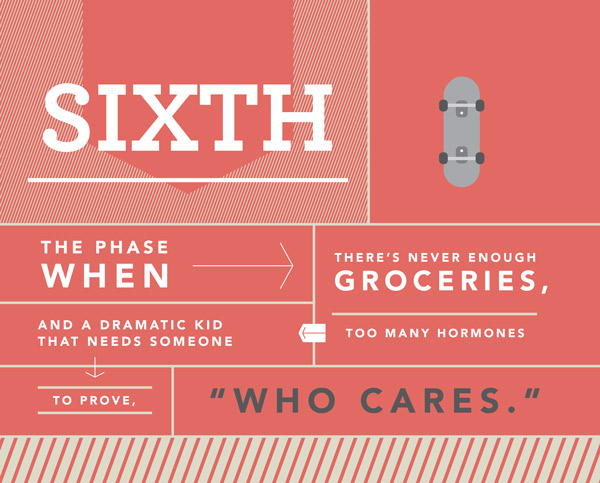
SIXTH GRADE

Crisis: Puberty – the turning point
Questions: Who do I like? Who likes me?
Goal: Provide stability.

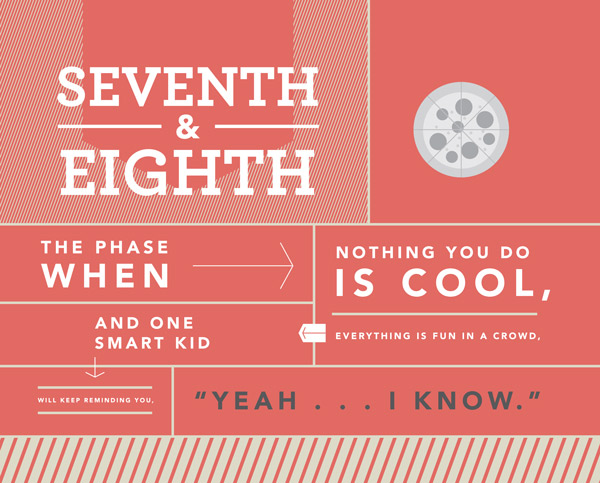
SEVENTH/EIGHTH GRADE

Crisis: Self-Awareness – the turning point
Questions: Who am I?
Goal: Help them discover uniqueness.


This is where empathy begins:
knowing and loving our middle schoolers.
And empathy is where influence begins.


Understanding our people helps us minister effectively and maximize our influence.

SINCE MONDAY IS COMING…

We need to affirm their personal journey.

A MIDDLE SCHOOLER IS AFFIRMED WHEN…

  • They are known.
  • They are loved and liked.
  • They are listened to more than they are talked to.
  • They are met at their level.
  • They get quality time with you.

*Affirmation is the fuel a middle schooler needs to face Monday.*

HOW CAN WE EQUIP MIDDLE SCHOOLERS FOR MONDAY?

  • Remind them they belong.
  • Give them Biblical teaching in a relevant way
  • Match them with a leader who will check-in with them during the week
  • Encourage them to lean into their community.
  • Pray for them regularly
  • Give them starting points so they can draw close to Jesus on their own
  • Utilize social media to encourage throughout the week

MONDAY IS COMING….

“For this reason, I kneel before the Father, from whom every family in heaven and on earth derives its name. I pray that out of his glorious riches he may strengthen you with power through his Spirit in your inner being, so that Christ may dwell in your hearts through faith. And I pray that you, being rooted and established in love, may have power, together with all the Lord’s holy people, to grasp how wide and long and high and deep is the love of Christ, and to know this love that surpasses knowledge—that you may be filled to the measure of all the fullness of God.” – Ephesians 3:14-19

KATIE EDWARDS
Middle School Pastor at Saddleback Church
Twitter | Instagram

What the Pope & Instagram Teach Us About Connecting with Students

Check out the Article Web Page Here

I’m sure the headline above appears a bit random. Is there really a common denominator between the Pope and Instagram co-founder Kevin Systrom?

Apparently, there is.

About a month ago, Instagram’s CEO and co-founder Kevin Systrom met with Pope Francis at the Vatican for the very first time. You already know, not everyone gets an audience with the Pope. What was the purpose of their meeting?

They met to discuss the power of images.

Instagram is now the fastest growing platform for social media sharing among the younger population, passing up Facebook from just a few years ago. Facebook remains the largest social media site, but it’s significant that they were smart enough to buy Instagram, foreseeing the trend toward posting and sending images over words. Systrom asserts they intend for Instagram to be the “dominant platform for visual communication.”

So, let’s listen in on the conversation between the Pope and Kevin Sysyrom. There were at least three realities that emerged as they conversed that we can integrate as we teach and lead students:

What Pope Francis and Kevin Systrom Reveal About the Power of Images:


pope-francis-707395_1280-371x278

Images unite generations and cultures.

This is literally what Kevin Systrom said to TIME magazine, which reported the meeting between the two leaders. Here were two men—one corporate, one sacred—connecting over a curated set of pictures that Systrom brought with him. He suggested that images unite people from different ages, different cultures and across all borders. Just think about international traffic signs. We’ve gone to images or icons because we all recognize their meaning, regardless of our language or culture. These images bring people together.

Images can tell stories in real time.

The set of images Kevin brought to Pope Francis told the stories of recent tragedies that people from all over the world had endured—pictures from the exodus of immigrants from Syria to Europe, to the Nepalese earthquake and its aftermath. In a picture, we can unveil so much without even saying a word. Images become the language. I remember pictures from history that connected me to the story of my country, and the narrative of my past.

Images reveal truth.

Finally, images can communicate a truth, whether it’s simple and straightforward, such as the trending photos of Taylor Swift’s 1989 tour., Or they can communicate pain—like the aftermath of the terrorist attack in Brussels, Belgium. They can also communicate hope —like the images of so many who are aiding refuges internationally. Images have the power to make us laugh or learn. Through symbolism, images often represent a truth or remind the viewer of an important axiom. And because they’re a metaphor—they’re disarming, even as they teach.

So What Do I Do with This Information?

These are but a handful of reasons I chose over the years to leverage images and narratives to teach leadership and life skills. They engage both the head and the heart—both hemispheres of the brain. Images make you think and feel at the same time. Each of our images, called Habitudes® (images that form leadership habits and attitudes), actually represent a timeless truth we believe the young must learn in order to lead themselves and others well. Since 2004, when we published the first Habitudes book, it’s been remarkable to see how memorable they are once students learn the truth that is captured in the image. I just spoke to a thirty year old who learned some of the Habitudes images back in college, a decade ago. She still remembers and uses them to this day.

So how do images impact our everyday lives?

If you’re communicating with colleagues, a study done by Social Bakers last year exposed the visual nature of social networking. The study indicated that photos trump the market on Facebook, making up 93 percent of the social network’s most engaging posts.

Research from Skyword found that when you’re sending a message—if your content includes compelling images, you can average 94 percent more views than your boring counterparts. Our eyes are drawn to visuals.

If you’re looking to get your message noticed on-line, a study done with Google+ users  revealed that images play a role in providing visual cues to grab someone’s attention on-line. Researchers found that a post on Google+ was three times more likely to be re-shared if it included an image.

So, what are we waiting for? It’s time we include images as we communicate. Get the picture?

– See more at: http://growingleaders.com/blog/pope-instagram-teach-us-connecting-students/#sthash.RQjUEPcx.dpuf

Playing the Long Game in a World Addicted to Instant

parentcuepic

by | Apr 4, 2016 | Blog, Imagine The End | 1 comment

Do you know why it’s hard to teach your kids perseverance?

Because the rest of the world is built around instantly fulfilling their every need.

Do you remember Blockbuster Video? You had absolutely no guarantee they would have the movie you wanted to rent. It was very likely that some other punk in your town beat you to the one copy of Back to the Future Part II.

Upon finding the empty case, you would curse your bad luck and then wait a few days until the video came back to the store. You had to persevere.

That might seem like an incredibly minor form of perseverance. It hardly fits the way we define the word here at Parent Cue. Were you really refusing to give up when life gets hard? Maybe not, but you did have to wait. You did have to try again. You did get reminded that the world is not structured around fulfilling your every need.

Fast forward to today and things are a lot different. If my phone takes longer than .05 seconds to look something up, I am frustrated. If the show my kids want to watch isn’t on Netflix, they feel a little impatient. If someone doesn’t respond to my text immediately, I am bothered.

We live in an on-demand world, but great things usually take great time.

It’s our job as parents to teach our kids that the things that really matter require perseverance.

You don’t get great relationships unless you work on them over time.

You don’t get great at a sport unless you practice even when you don’t feel like it.

You don’t get into a great college unless you start planning long before the application is due.

Despite what Siri might tell us, life is not instant and it is not always easy.

We’ve got to play for the long game.

When our kids want to quit on a school project, we have to remind them why sticking with it matters more.

When they want to give up on a friendship because their feelings got hurt, we have to remind them real relationships go through bumpy moments.

When they want to let go of a passion because practice isn’t fun, we have to show them the value of hard work.

As the rest of the world becomes impatient, a little bit of perseverance will pay dividends for years to come.

Jon_Acuff_BW_240

Jon Acuff

Jon Acuff is the New York Times Bestselling author of five books. His latest, Do Over: Rescue Monday, Reinvent Your Work & Never Get Stuck focuses on building a long-lasting career by investing in a “Career Savings Account.” Read his blog at Acuff.me and follow him on Twitter, @JonAcuff.

Tiger Woods Witnesses the First Hole-in-One at The Playgrounds

YouTubeYouCanUse

YoutubeVol6issue10pic

Tiger Woods Witnesses the First Hole-in-One at The Playgrounds

Volume 6, Issue 10

Video:

https://www.youtube.com/watch?v=NxAoz2eE_ZM

Topics:

Perfection

Bible:

Colossians 3:23-24

Discussion Starter:

Two junior golfers play a round of golf to open up a new course designed by Tiger Woods. One of them gets a hole in one on the very first hole, and it wasn’t Tiger Woods!

The person going before you does something absolutely perfect. How do you follow that knowing that you won’t be perfect?

While none of us may face this exact situation we all face a similar situation every day. Being a Christ follower means that we are “like Christ.” We strive to be like him in full knowledge that He was perfect and we are not. So how do we follow perfection? The Apostle Paul speaks to this in Colossians 3, “Whatever you do, work at it with all your heart, as working for the Lord, not for human masters, since you know that you will receive an inheritance from the Lord as a reward. It is the Lord Christ you are serving.”

In other words, you can’t be perfect but you can do whatever it is you need to do with all of your heart.

3 Questions:

  1. When was a time you did something perfectly?
  2. Is it easier for you to talk about the good things about yourself or the bad? Why do you think that is so?
  3. What’s one way you can “work at it with all your heart” this week?

Chew on this:

Is it OK to strive for perfection even if you know it’s impossible?


VIEW THE ARCHIVES

Risen Movie shares a new angle on the Resurrection Story

Risen Movie shares a new angle on the Resurrection Story

Sometimes we can look at the same story and pass it off as “routine.”  Risen takes you to a whole new angle of a story that could have happened.  I enjoyed it as entertainment, along with an impacting and uplifting story that gave me something to think about as we approach Easter.

FROM ‘THE PASSION OF THE CHRIST’ TO ‘RISEN’ WITH THE EDITORFilm Editor Steven Mirkovich knows how to create impact through films. With the critically acclaimed THE PASSION OF THE CHRIST film under his belt, Mirkovich was well prepared to tackle the editing of the new faith film RISEN, which is in theaters everywhere.”Whether you’re religious or not, it doesn’t matter with this film, because it’s an uplifting story that makes you feel hopeful. It’s a film that everyone should see,” said Mirkovich.

Watch as Mirkovich discusses the challenges of cutting down hundreds of hours of footage to create an inspirational portrayal of the impact that resulted from Christ’s life, death, and resurrection.