
The Other Person Your Child Needs

thinkstockphotos-487918287-1280x640

Posted by | , ,

We’re miles apart connected through cell phones, but the smile I feel in her voice sinks into my bones. With me, through moves across the country, career changes, moments when I was feeling sorry for myself, and times I needed to celebrate, Sibyl always had the words that hit the spot. She’s never shied away from saying what was hard  (she once told me to get off my butt and get started). But her words mattered because they were spoken from someone who knew me and loved me.

We know as adults we need these voices in our lives, but there’s someone who needs them even more: your child.

Wait a minute, your child has you, right? You’re the awesome parent who loves them more than anyone else in the world.

Exactly. You see your child through parent eyes, filled with hope and an achingly deep love that wants them to always try their best, always step into that next opportunity, always get that A, because you know they can do it. You were there the moment they made their grand entrance. You’re the one with the naked baby butt stories they beg you not to tell.

No way can an outside voice ever take your place, but they can fill a different seat at the table that you can’t.

Let’s face it. Somewhere between Lululemon and man buns, you’ve lost your coolness (okay, you haven’t lost it, you just can’t find it at the moment). You’re still essential, but now, there’s more your child needs. They need an additional, I-know-what-you’re-feeling voice. Here’s why:

They need a listening ear that’s not you, because sometimes it’s about you. Geesh, I don’t want my child talking to someone else about me! Actually, you do. Remember that time you made your daughter march back to her room (okay, she stomped) because the shorts she had on didn’t cover the essentials? She felt like you had ruined her life. When she talks to her friends about it, they’re on her side, which isn’t always helpful. When she talks to another wise adult she trusts, they can help with the why behind the what and help her see you’re on her side too. Which is incredibly helpful.

They need someone to sit with them at ground zero. As parents, we want to get them past what hurts and help lift their eyes to tomorrow. But when something hurts, it hurts today. Your child needs someone to talk to that remembers what it feels like to sit at the lunch table alone, left out of the Friday night party, or dumped by their best friend. As parents, it’s tempting to talk them out of feeling sad. It’s okay, there are lots of other parties. But often, they are not ready for this conversation yet. This is where an outside person can “sit in it” with them and help them process their feelings, giving them time for perspective to seep in.

Some things are too itchy for a parent’s ears. We want our kids to talk to us about the hard stuff. Pornography, sexting, what their best friend got arrested for last night, that decision they made that turned out to be a terrible one. But this is where an outside person can be extremely valuable. They can listen without freaking out, bring some wise words and help your child see why they do need to share it with you. A wise outside voice they trust who also reinforces your family relationship and your family values is like gold, and it keeps your child from feeling isolated with things that feel too big to talk about.

If your child already has someone they can talk to that you trust, like a teacher, coach, small group leader, mentor, let your child know you’re okay with it. Be supportive of their conversations, letting them know they can share what they talk about, but don’t force it. And honor the relationship by allowing time for it.

But what if your child doesn’t have an outside voice?

Ask a leader in your church or at their school if there are any young adults they know well who may already be volunteering and would be willing to mentor or be a big brother or sister. Relationship is key here, so make sure it’s someone your kid can connect with.

If your church has small groups for children and students, encourage your child to join. Remember, that other voice doesn’t always have to be one on one. Sitting in a group of kids the same age with a great leader can be an incredible start.

Wherever you find the other person your child needs, get to know them, invite them to have coffee, and thank them for investing in your child.

Check out more Parent Cue Posts here

How to Build Lasting Integrity in Kids

Icebergs and Ice Cubes

Check out the growing leaders blog here

An iceberg has been used over and over again by instructors to illustrate hidden realities. We often talk about the “tip of the iceberg” meaning there’s a larger amount of unseen substance than what’s visible. It’s an analogy. The iceberg is one of our most popular Habitude images when we teach leadership to students.

It has everything to do with integrity.

I believe the ten percent that lies above the water line represents our skills. They’re visible. Everyone can see them. But, they’re only the tip of our influence. The 90 percent that lies beneath the surface represents our character. And it’s always what is below the surface that sinks the ship.

Consider the Titanic for a moment. That tragic shipwreck that killed hundreds of people on board wasn’t due to the tip of the iceberg. It was that massive amount that’s invisible. It’s true about most failures in life, as well. I don’t know anyone who’s derailed their life with a technique flaw. I do, however, know several people who’ve derailed their career or their marriage or their friendships due to a character flaw.

When we teach our children character, (whether they’re six or sixteen), we cultivate substance beneath the surface. It can’t be seen, but in the long run it will surely impact the substance and direction of their lives. It’s invisible but important. The fact is, the majority of our influence lies in qualities beneath the surface.

My guess is—you’re a parent who wants to raise your children to be people with integrity. You want them to live by values, to be honest and ethical and to build a solid reputation. It’s a noble goal, but one that’s not easy to achieve today.

Why Is This so Challenging to Develop?

Becoming a person of integrity is difficult because our society places so much emphasis on what we can see. Our talent. Our Facebook profile. Our selfies. Our appearance. It’s almost always about our image not our integrity. If our kids display any special gifts or leadership qualities, it can be doubly hard. Consider these four statements:

  1. Their talent has the potential to carry them further than their character can sustain them. Without direction, their gift can mold them into someone they don’t intend to become. They’ll be tempted to use their gifts to go places their character isn’t robust enough to guide them or keep them aligned with good ethics.
  1. Trouble comes when their integrity doesn’t keep pace with the momentum created by their intelligence. Sometimes our intelligence is much stronger than our character. Our moral intelligence isn’t strong enough to give us clarity to make good choices. Smart kids can rationalize almost any misbehavior or poor decision.
  1. There is no correlation between giftedness and maturity. It’s easy to assume that a talented athlete, student council member or performer must be a mature leader. Not true. A person can have great gifts . . . and be the most immature person in the world. Unfortunately, they can still have influence. We must help our kids see the difference.
  1. Their commitment to integrity can be easily eroded by their love of progress. If a student lacks integrity, it doesn’t mean they’re inherently bad people. It may mean they are leaders and this is pushing them forward. Leaders want to make progress! Because they love progress they can compromise a commitment to integrity.

In addition, we live in a day of pluralism and tolerance, where we’ve taught our children to value and accept all points of view. This is a good thing. Unfortunately, kids can unwittingly fail to distinguish perspectives that are just plain wrong or unethical. The unintended consequence can be that kids fail to develop the ability to discern right from wrong. They don’t want to be judgmental, so they withdraw from making even moral judgments. This inability will be conspicuous as they begin their careers.

What Can You Do?

Let me suggest a handful of action steps you can take with your kids:

1. Make a list of values.

One of the two greatest goals you can model and teach to your children is to help them create a list of 4-6 words that describe the person they hope to become as adults. Call it a list of personal core values. Then, help them find ways to live up to those values weekly.

2. Challenge them to add value to others daily.

Next, in addition to living by values, give them perspective on adding value to others. Help them to perform one act every day that adds value to someone else. Try doing it yourself. Living by values and adding value are what makes people valuable to teams.

3. Make it a game to do what you disdain.

Challenge the family to choose something every week that you each don’t like to do, and do it daily. It may be a chore around the house, like taking out the garbage. Keep score on parents and kids. This creates a habit of doing right—even when it’s no fun.

4. Dinner check ups on integrity.

At dinner, talk about a weekly opportunity each family member had to practice something that displayed integrity when no one was watching. Anonymous acts of character. Affirm any growth in each person.

An Iceberg Not an Ice Cube

These simple acts can begin to cultivate kids with robust character. Kids who grow below the surface. Solid. Stable. Steady. Interestingly, there is such a thing as an iceberg that has very little substance below the surface. It’s called a “whistler.” They have nothing more underwater than what’s above. They’re like a floating ice cube. Do you know how you can identify a “whistler?” They consistently make noise as they drift.

Let’s raise our kids to have substance below the surface.

Monday in the Life of a Middle Schooler

MSPhase6web MSPhase7&8web

Check out http://justaphase.com/oc16/monday-in-the-life-of-a-middle-schooler/

Monday in the Life of a Middle Schooler


“You can’t speak the truth in love if you don’t love who you are speaking to.” – Reggie Joiner

EMPATHY BEGINS WHEN WE UNDERSTAND THIS PHASE

What was life like for you as a middle schooler?
What is life like for middle schoolers today?

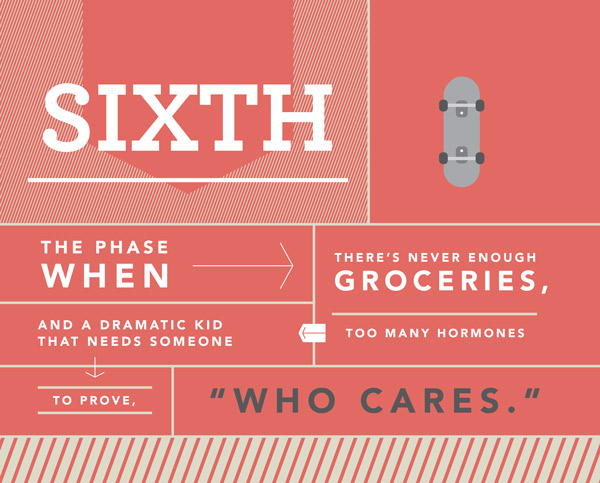
SIXTH GRADE

Crisis: Puberty – the turning point
Questions: Who do I like? Who likes me?
Goal: Provide stability.

SEVENTH/EIGHTH GRADE

Crisis: Self-Awareness – the turning point
Questions: Who am I?
Goal: Help them discover uniqueness.


This is where empathy begins:
knowing and loving our middle schoolers.
And empathy is where influence begins.


Understanding our people helps us minister effectively and maximize our influence.

SINCE MONDAY IS COMING…

We need to affirm their personal journey.

A MIDDLE SCHOOLER IS AFFIRMED WHEN…

  • They are known.
  • They are loved and liked.
  • They are listened to more than they are talked to.
  • They are met at their level.
  • They get quality time with you.

*Affirmation is the fuel a middle schooler needs to face Monday.*

HOW CAN WE EQUIP MIDDLE SCHOOLERS FOR MONDAY?

  • Remind them they belong.
  • Give them Biblical teaching in a relevant way
  • Match them with a leader who will check-in with them during the week
  • Encourage them to lean into their community.
  • Pray for them regularly
  • Give them starting points so they can draw close to Jesus on their own
  • Utilize social media to encourage throughout the week

MONDAY IS COMING….

“For this reason, I kneel before the Father, from whom every family in heaven and on earth derives its name. I pray that out of his glorious riches he may strengthen you with power through his Spirit in your inner being, so that Christ may dwell in your hearts through faith. And I pray that you, being rooted and established in love, may have power, together with all the Lord’s holy people, to grasp how wide and long and high and deep is the love of Christ, and to know this love that surpasses knowledge—that you may be filled to the measure of all the fullness of God.” – Ephesians 3:14-19

KATIE EDWARDS
Middle School Pastor at Saddleback Church
Twitter | Instagram

What the Pope & Instagram Teach Us About Connecting with Students

Check out the Article Web Page Here

I’m sure the headline above appears a bit random. Is there really a common denominator between the Pope and Instagram co-founder Kevin Systrom?

Apparently, there is.

About a month ago, Instagram’s CEO and co-founder Kevin Systrom met with Pope Francis at the Vatican for the very first time. You already know, not everyone gets an audience with the Pope. What was the purpose of their meeting?

They met to discuss the power of images.

Instagram is now the fastest growing platform for social media sharing among the younger population, passing up Facebook from just a few years ago. Facebook remains the largest social media site, but it’s significant that they were smart enough to buy Instagram, foreseeing the trend toward posting and sending images over words. Systrom asserts they intend for Instagram to be the “dominant platform for visual communication.”

So, let’s listen in on the conversation between the Pope and Kevin Sysyrom. There were at least three realities that emerged as they conversed that we can integrate as we teach and lead students:

What Pope Francis and Kevin Systrom Reveal About the Power of Images:


pope-francis-707395_1280-371x278

Images unite generations and cultures.

This is literally what Kevin Systrom said to TIME magazine, which reported the meeting between the two leaders. Here were two men—one corporate, one sacred—connecting over a curated set of pictures that Systrom brought with him. He suggested that images unite people from different ages, different cultures and across all borders. Just think about international traffic signs. We’ve gone to images or icons because we all recognize their meaning, regardless of our language or culture. These images bring people together.

Images can tell stories in real time.

The set of images Kevin brought to Pope Francis told the stories of recent tragedies that people from all over the world had endured—pictures from the exodus of immigrants from Syria to Europe, to the Nepalese earthquake and its aftermath. In a picture, we can unveil so much without even saying a word. Images become the language. I remember pictures from history that connected me to the story of my country, and the narrative of my past.

Images reveal truth.

Finally, images can communicate a truth, whether it’s simple and straightforward, such as the trending photos of Taylor Swift’s 1989 tour., Or they can communicate pain—like the aftermath of the terrorist attack in Brussels, Belgium. They can also communicate hope —like the images of so many who are aiding refuges internationally. Images have the power to make us laugh or learn. Through symbolism, images often represent a truth or remind the viewer of an important axiom. And because they’re a metaphor—they’re disarming, even as they teach.

So What Do I Do with This Information?

These are but a handful of reasons I chose over the years to leverage images and narratives to teach leadership and life skills. They engage both the head and the heart—both hemispheres of the brain. Images make you think and feel at the same time. Each of our images, called Habitudes® (images that form leadership habits and attitudes), actually represent a timeless truth we believe the young must learn in order to lead themselves and others well. Since 2004, when we published the first Habitudes book, it’s been remarkable to see how memorable they are once students learn the truth that is captured in the image. I just spoke to a thirty year old who learned some of the Habitudes images back in college, a decade ago. She still remembers and uses them to this day.

So how do images impact our everyday lives?

If you’re communicating with colleagues, a study done by Social Bakers last year exposed the visual nature of social networking. The study indicated that photos trump the market on Facebook, making up 93 percent of the social network’s most engaging posts.

Research from Skyword found that when you’re sending a message—if your content includes compelling images, you can average 94 percent more views than your boring counterparts. Our eyes are drawn to visuals.

If you’re looking to get your message noticed on-line, a study done with Google+ users  revealed that images play a role in providing visual cues to grab someone’s attention on-line. Researchers found that a post on Google+ was three times more likely to be re-shared if it included an image.

So, what are we waiting for? It’s time we include images as we communicate. Get the picture?

– See more at: http://growingleaders.com/blog/pope-instagram-teach-us-connecting-students/#sthash.RQjUEPcx.dpuf

Playing the Long Game in a World Addicted to Instant

parentcuepic

by | Apr 4, 2016 | Blog, Imagine The End | 1 comment

Do you know why it’s hard to teach your kids perseverance?

Because the rest of the world is built around instantly fulfilling their every need.

Do you remember Blockbuster Video? You had absolutely no guarantee they would have the movie you wanted to rent. It was very likely that some other punk in your town beat you to the one copy of Back to the Future Part II.

Upon finding the empty case, you would curse your bad luck and then wait a few days until the video came back to the store. You had to persevere.

That might seem like an incredibly minor form of perseverance. It hardly fits the way we define the word here at Parent Cue. Were you really refusing to give up when life gets hard? Maybe not, but you did have to wait. You did have to try again. You did get reminded that the world is not structured around fulfilling your every need.

Fast forward to today and things are a lot different. If my phone takes longer than .05 seconds to look something up, I am frustrated. If the show my kids want to watch isn’t on Netflix, they feel a little impatient. If someone doesn’t respond to my text immediately, I am bothered.

We live in an on-demand world, but great things usually take great time.

It’s our job as parents to teach our kids that the things that really matter require perseverance.

You don’t get great relationships unless you work on them over time.

You don’t get great at a sport unless you practice even when you don’t feel like it.

You don’t get into a great college unless you start planning long before the application is due.

Despite what Siri might tell us, life is not instant and it is not always easy.

We’ve got to play for the long game.

When our kids want to quit on a school project, we have to remind them why sticking with it matters more.

When they want to give up on a friendship because their feelings got hurt, we have to remind them real relationships go through bumpy moments.

When they want to let go of a passion because practice isn’t fun, we have to show them the value of hard work.

As the rest of the world becomes impatient, a little bit of perseverance will pay dividends for years to come.

Jon_Acuff_BW_240

Jon Acuff

Jon Acuff is the New York Times Bestselling author of five books. His latest, Do Over: Rescue Monday, Reinvent Your Work & Never Get Stuck focuses on building a long-lasting career by investing in a “Career Savings Account.” Read his blog at Acuff.me and follow him on Twitter, @JonAcuff.

Tiger Woods Witnesses the First Hole-in-One at The Playgrounds

YouTubeYouCanUse

YoutubeVol6issue10pic

Tiger Woods Witnesses the First Hole-in-One at The Playgrounds

Volume 6, Issue 10

Video:

https://www.youtube.com/watch?v=NxAoz2eE_ZM

Topics:

Perfection

Bible:

Colossians 3:23-24

Discussion Starter:

Two junior golfers play a round of golf to open up a new course designed by Tiger Woods. One of them gets a hole in one on the very first hole, and it wasn’t Tiger Woods!

The person going before you does something absolutely perfect. How do you follow that knowing that you won’t be perfect?

While none of us may face this exact situation we all face a similar situation every day. Being a Christ follower means that we are “like Christ.” We strive to be like him in full knowledge that He was perfect and we are not. So how do we follow perfection? The Apostle Paul speaks to this in Colossians 3, “Whatever you do, work at it with all your heart, as working for the Lord, not for human masters, since you know that you will receive an inheritance from the Lord as a reward. It is the Lord Christ you are serving.”

In other words, you can’t be perfect but you can do whatever it is you need to do with all of your heart.

3 Questions:

  1. When was a time you did something perfectly?
  2. Is it easier for you to talk about the good things about yourself or the bad? Why do you think that is so?
  3. What’s one way you can “work at it with all your heart” this week?

Chew on this:

Is it OK to strive for perfection even if you know it’s impossible?


VIEW THE ARCHIVES

Generation iY – Tim Elmore

Source: Generation iY – Tim Elmore

One of the most significant discoveries researchers have made on both Millennials and Generation Z (kids growing up since the dawn of the 21st century) is that they have been conditioned to fear failure. Some kids are so paralyzed by the thought of failing, they’ll do anything to avoid it:

  • Quit the team.
  • Cheat on a test.
  • Lie about their results.
  • Never try in the first place.

According to one study, conducted by Bilkent University in Turkey, this fear of failure has gone global in 21st century students. The study found that the “fear of failure at school can negatively affect a student’s motivation and attitude to learn.”

The researchers asked over 1,000 high school and college students to complete surveys about their motivation to learn and the strategies they employed. In the end, they discovered that kids who feared failure at an early age were more likely to create goals to validate their ego rather than help them grow and develop. These students were also less likely to utilize “effective learning strategies” and “more likely to cheat.”

Ouch. Did anyone see this coming?

In 2003, research performed by Wiley Periodicals noted that one of three psychological variables that hinder adolescents’ levels of school engagement was the fear of failure. Hmmm. I think I see a pattern here.

The Golden Gate Paradox

golden-gate-bridge-1081782_1280-417x278

There is a great story that informs how we should lead students through this awful fear and liberate them from it. (I share it in my book, Twelve Huge Mistakes Parents Can Avoid.) In 1933, when the Golden Gate Bridge was being built, the crew fell behind on their deadlines. One of the workers had fallen to his death causing his colleagues to work more slowly each day for fear it might happen again. Finally, one worker approached the supervisor and asked if a net could be placed underneath the men to prevent them from dying if they fell. The supervisor was apprehensive to take the time to do this because they were already behind schedule. But, alas, he agreed and a net was hoisted into position. Suddenly, the men worked faster and more efficiently—actually speeding up the completion of the bridge. What enabled them to work faster and better? Removing the fear of failure. Suddenly, it was safe to try what they had feared before.

I call this the Golden Gate Paradox. Once the workers were liberated from the fear of failure—they could fall without fatality—they worked and succeeded better than ever. And faster then ever. Without the fear of failure, they failed less. The bridge was finished. The foreman met his deadline. The workers were safe. Everyone won.

In the end, people (especially students) need safety nets in order for them to welcome failure as part of the learning process. Safety nets are:

  • Motivating. (They want to jump in, take risks and initiate action.)
  • Liberating. (They feel free to explore, learn and grow without worry.)

What makes this “safety net” act challenging for staff and faculty is removing student’s fear of failure without neglecting to teach the reality of consequences. In other words, far too often we adults have rescued students from their failures, and they never learn to navigate or face the consequences for their mistakes.

Leaders must be dispensers of grace, allowing followers to fail forward, and not quit or flunk out when mistakes are made. This actually enables them to succeed more often and more quickly. However, leaders must also condition followers to weigh out the ramifications for their decisions and actions. So we must balance both:

  • Safety (It’s OK to fail as you learn).
  • Reality (Every action has an outcome).

Suggestions for Safety Nets

Here are some ideas you can tweak to perform the Golden Gate Paradox:

  1. Start by telling stories of your failures, without celebrating them. Liberate the students by revealing that you failed at some past ventures and lived to tell about it. In fact, you learned.
  2. Communicate the boundaries for their mistakes and don’t remove every consequence. Ease them into the new scenario; let them push the envelope.
  3. Host a course called “Failure 101.” More than one school has initiated such a class especially for students who fear it. It’s all about learning from failure.
  4. When possible, offer second chances for fearful students. Many adults are so angry at Gen iY kids, they remove all second chances. This is ultimately harmful.
  5. Gradually, condition them to welcome failure as part of their learning. Expose them to responsibility as they gain more autonomy. These two go together.
  6. Find out what they fear the most and address it. Perhaps they fear looking bad or disappointing mom. Once you help them identify it, address the cause.

Let’s hoist some safety nets and watch our students flourish.

– See more at: http://growingleaders.com/blog/category/generation-iy/#sthash.6BSOqUpA.dpuf

Risen Movie shares a new angle on the Resurrection Story

Risen Movie shares a new angle on the Resurrection Story

Sometimes we can look at the same story and pass it off as “routine.”  Risen takes you to a whole new angle of a story that could have happened.  I enjoyed it as entertainment, along with an impacting and uplifting story that gave me something to think about as we approach Easter.

FROM ‘THE PASSION OF THE CHRIST’ TO ‘RISEN’ WITH THE EDITORFilm Editor Steven Mirkovich knows how to create impact through films. With the critically acclaimed THE PASSION OF THE CHRIST film under his belt, Mirkovich was well prepared to tackle the editing of the new faith film RISEN, which is in theaters everywhere.”Whether you’re religious or not, it doesn’t matter with this film, because it’s an uplifting story that makes you feel hopeful. It’s a film that everyone should see,” said Mirkovich.

Watch as Mirkovich discusses the challenges of cutting down hundreds of hours of footage to create an inspirational portrayal of the impact that resulted from Christ’s life, death, and resurrection.


Why Fun Environments Matter for a Middle Schooler’s Faith | Uthmin

Why Fun Environments Matter for a Middle Schooler’s Faith | Uthmin.

fun-environments

If you know anything about me or Kenny, you probably already know that we are big fans of having tons of fun. From the time our middle schoolers walk through the doors of our church, to the time they leave, we really want them to enjoy being there.

For our ministry, having fun isn’t just an afterthought. It’s a priority and a strategy.

But you know what? Sometimes I come across people who really don’t like this idea. As Reggie Joiner said recently, “I am shocked at how many people are bothered by children and student ministries having fun.”

I’m shocked too. And I’m also a little sad. Because when we fail to prioritize having fun at churchI’m convinced we miss out on something vital to the development of a middle schooler’s faith. 

Yeah, it’s that serious.

Here’s why.

1. FUN ENVIRONMENTS HELP MIDDLE SCHOOLERS SEE WHAT JESUS IS LIKE. 

Having fun is a powerful expression and working-out of the joy and freedom and abundant life we find in Jesus. So having fun with our students isn’t trivial or irreverent or a waste of time. It’s sacred and holy and it makes Jesus smile. We’ve got to model this for our middle schoolers. As we create environments that are jam-packed with Jesus and amazing, hilarious, super fun memories… we’re teaching them that God is the God of whimsy and smiles and laughter and all things good, and that it’s a joy to follow Him. I don’t know about you, but I find that pretty compelling.

2. FUN ENVIRONMENTS CONNECT THEM TO A COMMUNITY.

We all know how important it is for middle schoolers to feel they belong. If we want to help middle schoolers build a strong community with their peers and trusted adults, then laughing, playing, sharing jokes, and making memories together are vital. So when our middle schoolers are sticking their feet in Jell-O, launching giant Angry Birds from a volleyball net together, or helping their blindfolded friend guess what mystery ingredient we put in their bowl of cereal… well, in the words of J.K. Rowling, “There are some things you can’t share without ending up liking each other.”

3. FUN ENVIRONMENTS HELP THEM NOT TAKE THEMSELVES TOO SERIOUSLY.

Middle school has to be the most awkward time in all of human existence. Our students are plagued by insecurities and the need to be liked and accepted. But is it possible to simultaneously be having an insane amount of fun and also feel awkward and self-conscious? No. No, it’s not. When we manage to coax middle schoolers into having fun, we’re also coaxing them into letting down their defenses and forgetting, even if it’s just for a moment, about their insecurities and fears. It’s good for their hearts.

4. FUN ENVIRONMENTS CREATE OPPORTUNITIES FOR DISCIPLESHIP.

Trying to create fun environments for middle schoolers can be an interesting social experiment. Our middle school friends are cute little bundles of insecurity and immaturity. And, because of that, sometimes our super fun plans go up in smoke and the awesome environments we’ve tried to create… well, implode. Someone gets an attitude. A guy gets too aggressive. A girl gets insecure. Someone gets teased. A joke goes too far. It happens. Conflict happens. But you know what? That’s ok. Because when things get messy, we get the opportunity to coach them through it. We shouldn’t run from creating fun environments because we fear the conflict that might happen as a result. Let’s run toward the messiness, embrace it, and then leverage those moments for discipleship.

What do you think? How have you seen fun environments make a difference in the life and faith of a middle schooler?

Elle Campbell

About Elle Campbell

Elle is doing Middle School Ministry at The Chapel at CrossPoint in Buffalo, New York, where she focuses mostly on creating great small group environments and leading volunteers. She blogs about youth ministry stuff at ellecampbell.org and creates and shares original youth ministry resources at stuffyoucanuse.org. She is married to Kenny and loves coffee and making things and reading as many books as possible. You can find her on Twitter, Facebook, and Instagram.